Real-time Kp index, solar wind, solar flares and aurora — updated continuously from NOAA SWPC. Loading the latest conditions…
Aurora: —Drag: —HF: —
Plain-English summary · live · from NOAA SWPC
Reading the latest space-weather conditions…
Right now — the Sun's vital signs
Live · 60s
Eight live readings that together describe the state of space weather. Each shows the number an expert wants and a plain-English meaning for everyone else. Updated every minute from NOAA SWPC.
Kp index
—
Loading live conditions…
The NOAA storm scales
Educational
Space weather is graded on official scales — like the Saffir–Simpson scale for hurricanes. Here's where we are right now on each.
G — Geomagnetic storms
How disturbed Earth's magnetic field is. Drives aurora, GPS error and satellite drag.
G1Minor
G2Moderate
G3Strong
G4Severe
G5Extreme
R — Radio blackouts
HF radio fade-outs on Earth's sunlit side, caused by X-ray solar flares.
R1Minor
R2Moderate
R3Strong
R4Severe
R5Extreme
S — Radiation storms
Energetic solar protons — a risk to astronauts, polar flights and satellite electronics.
S0None / Quiet
S1Minor
S2Moderate
S3Strong
S4Severe
3-day storm & aurora forecast
Predictive
NOAA's predicted planetary Kp index for each 3-hour window (UTC), colour-coded by storm level. Plan your aurora hunt around the peaks.
Loading NOAA's 3-day Kp forecast…
Aurora outlook:Loading NOAA's 3-day Kp forecast…
Rewind the storm
Time machine
Drag back through the last 72 hours and watch conditions build — the same DSCOVR & GOES feeds, replayed: the IMF Bz, the Kp index and solar-wind speed at any moment you pick.
Showing now · live
Bz · IMF
—
Kp index
—
Solar wind
—
−72h−54h−36h−18hnow
Bz (IMF)Kp indexSolar wind
Aurora tonight — where you are
Personalised
Your personal aurora chance, sampled live from NOAA's Ovation model at your location — the probability the lights are overhead right now. Allow location for your exact spot, or it defaults to London.
AURORA OVAL · NORTH
you
—
finding your location…
Allow location to see your personal aurora chance.
Impact on tracked satellites
Live
Geomagnetic storms heat and puff up the upper atmosphere, dragging low satellites down faster. This is the live effect on the objects Orbital Radar tracks — something only a tracking platform can show.
How the solar wind hits Earth's magnetic shield. As a storm intensifies the dayside magnetopause compresses, the solar wind quickens and the aurora ovals flare — the diagram reacts to the live state above.
Magnetosphere — cross-section · reacts to the live storm state
As the storm state changes, the dayside compresses and reconnection feeds energy into the system — driving the aurora and the extra satellite drag shown above.
What it affects on Earth
At a glance
Space weather isn't abstract — it touches GPS, flights, radio and power grids. Here's the live status across every sector, graded from NOAA SWPC conditions.
GPS & GNSS
Loading live conditions…
The Sun, live
Auto-updating
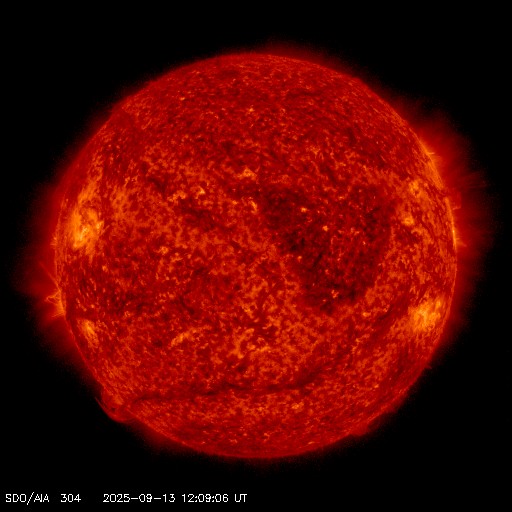
Direct from NASA's Solar Dynamics Observatory and NOAA — refreshed continuously. Watch active regions, coronal holes and flares develop.
Is a coronal mass ejection heading our way? When NASA models an Earth-bound eruption, its forecast arrival shows here — with the honest caveat that the true strength isn't known until it reaches the spacecraft at L1.
Checking for inbound CMEs…
Loading the latest NASA DONKI / WSA-Enlil model run…
L1 tripwire: a CME's true strength can't be confirmed until it reaches the DSCOVR spacecraft ~1.5 million km out — then it's known only ~15–60 minutes before impact. Arrival times are modelled windows, not exact. NASA DONKI · WSA-Enlil · DSCOVR @ L1
Where it hits — regional impact
Live · factual
A solar storm doesn't strike a single city — it lights up whole latitude bands. In plain terms: can you see the aurora tonight, and does it mean anything where you are? Pick a location to check. Power-grid detail (North America) is shown separately, for operators.
Tonight's aurora — where you can see it
loading map…
Aurora possible tonightCities that may see itYouGrid hazard · N. America (operators)
Plain-language and modelled for your location — not a measurement. For most people even a strong storm just means aurora and slightly-off GPS; real infrastructure risk only at the extreme (G4–G5) end.
Understand what's happening
For everyone
New to space weather? Read it in plain English. Already fluent? Flip to Pro for the physics and thresholds.
The Sun constantly blows a stream of charged particles — the solar wind — past Earth. When the Sun is stormy, it hurls extra bursts of energy and magnetism our way. That's space weather, and it shapes auroras, can nudge satellites and occasionally disrupts radio and power on the ground.Physics: the heliospheric current sheet and embedded IMF couple to the magnetosphere via dayside reconnection when Bz turns southward. Energy loading drives the substorm cycle, ring-current intensification (measured by Dst), and field-aligned currents that close through the auroral ionosphere.
Kp is a 0–9 score for how disturbed Earth's magnetic field is right now. Below 4 is calm. At 5 a storm starts (and aurora pushes south). 7+ is a big storm. It's the single best number for "will I see the aurora tonight?".Detail: Kp is a quasi-logarithmic, 3-hourly planetary index from 13 mid-latitude magnetometers, in thirds (5−, 5, 5+). It maps to the NOAA G-scale (Kp5→G1 … Kp9→G5) and tracks the equatorward boundary of the auroral oval.
Bz is the direction of the magnetic field arriving in the solar wind. When it points south, it links up with Earth's field like two magnets clicking together — and that's what really powers a storm. North-pointing Bz, and not much happens.Detail: southward IMF Bz (GSM) enables dayside merging per the Dungey cycle; the reconnection rate scales roughly with v·Bz·sin⁴(θ/2). Sustained Bz < −10 nT with elevated speed is the classic strong-storm driver.
Put live space weather on your site
Free badge
A free badge that always shows the current conditions and links back to Orbital Radar. One line of HTML, no maintenance — and every embed is a live backlink.
SPACE WEATHER
G0
Loading current conditions…
LIVE · orbitalradar.com
One line of HTML. Always current.
It pulls the same NOAA-derived data as this page and refreshes itself — no maintenance for whoever embeds it. The G-scale, Kp index and aurora outlook, in a compact badge that links back to the live hub.
 LIVE
LIVE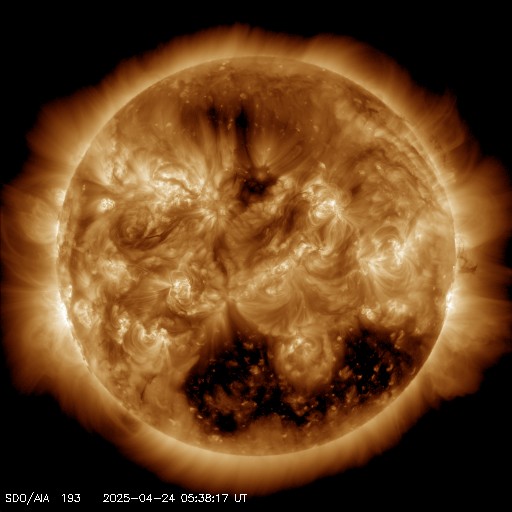 LIVE
LIVE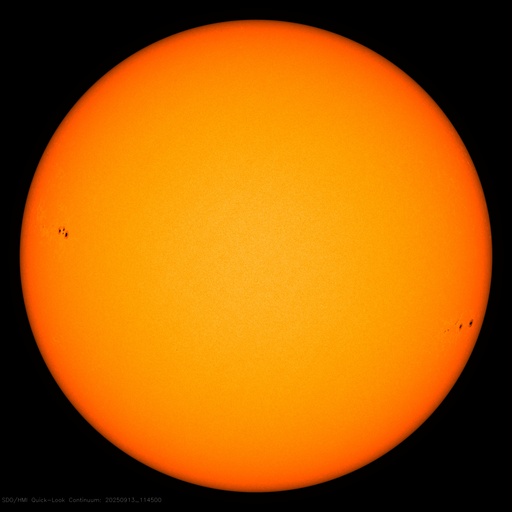 LIVE
LIVE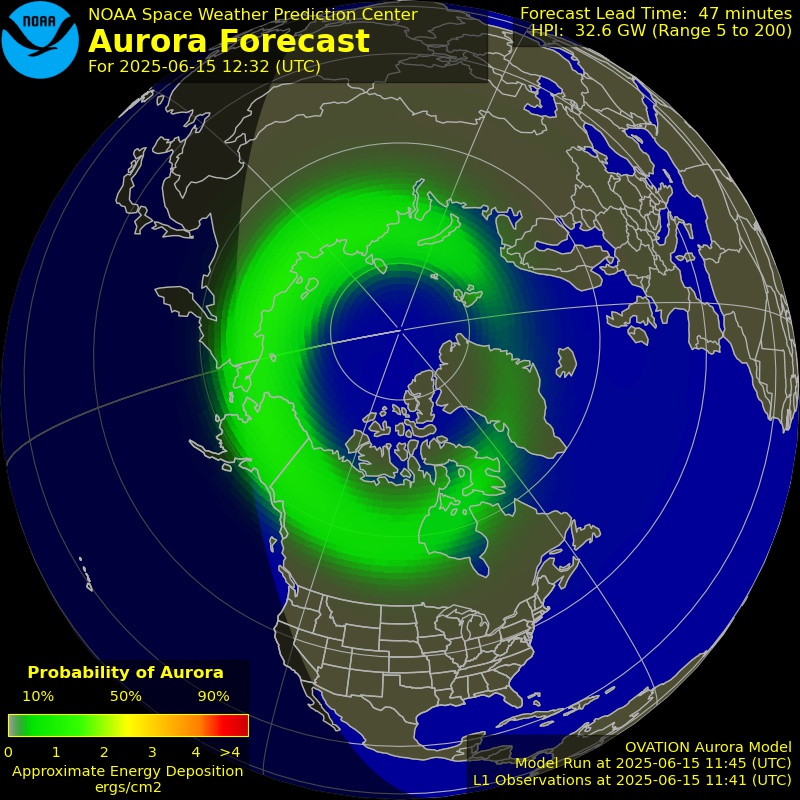 LIVE
LIVE